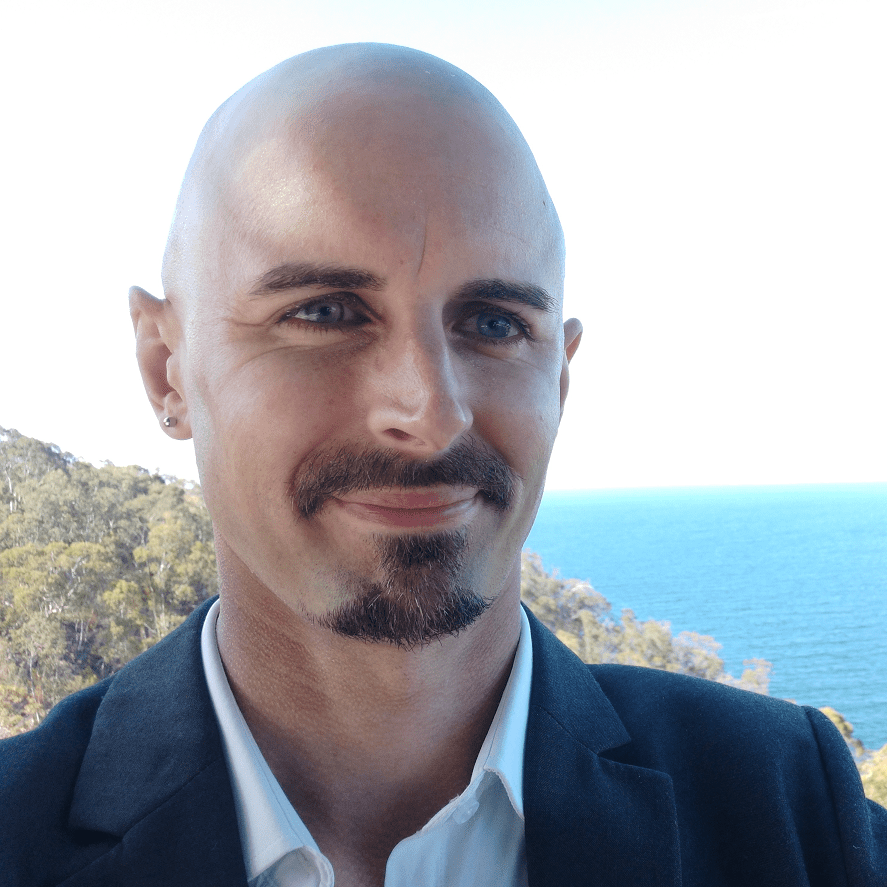
Greetings! This site does little more than communicate and store the miscellaneous writings of me, Dominic, a Tasmanian writer and film scholar. My writing interests include film, literature, and mindfulness topics, with the odd foray into rock and roll, or whatever else snags my fancy.
I gained a PhD in English in 2009 from the University of Tasmania, where I later ran the first-year English program, as well as courses such as Popular Fiction, Literary Theory, 19th Century British Literature, and several film studies courses. I’m the author of two full-length non-fiction books on cinema, several study-guide books for senior secondary students, and a range of academic book chapters (see Publications for more information).
Since 2012, I’ve been a lecturer in the University’s enabling and bridging programs, where I teach classes focused on study skills, writing, research, and communication. I’m grateful to use my skills in these areas to prepare and support learners to fulfill their aspirations. I’m one person in a dedicated team focused on expanding educational opportunities for those in Tasmania and beyond.
Contact:
- Email: dwlennard[at]protonmail.com
- University of Tasmania profile
- LinkedIn profile
From Reviews:
“[In Brute Force] Lennard’s is the best kind of criticism—the kind that both satisfies our craving for causal explanation and increases our appreciation of the works under discussion. . . . Lennard’s compositional flair, in combination with his keen interpretive vision and his command of the relevant science, makes this book a real gem—eminently readable, full of insight, and suffused with good sense. . . . [This] book deserves a large audience.”
—Assoc. Prof. Mathias Clasen (Aarhus University), author of Why Horror Seduces, writing in Evolutionary Studies in Imaginative Culture (vol. 4, no. 2, 2020).
“The brilliance of Dominic Lennard’s Brute Force is not only that it is long overdue, but one didn’t realize it was due in the first place! Yet upon reflection and, of course, through Lennard’s engaging book, one realizes not only the ubiquity of animals in horror, but their utter centrality to so many classic horror films. In reading this, we can hear the distant rumble of footsteps of a genetically reborn Tyrannosaurus or the hurried pounding of our beloved Rover who has decided that he wants more than kibbles and bits for dinner—and we look mighty appetizing. ‘Groundbreaking’ is often overused, but in this case it truly fits.”
—Emeritus Professor David Desser, University of Illinois at Urbana-Champaign
“[Lennard] may discuss the sexual politics of 1976’s King Kong and the gender depiction of bears, but don’t mistake Brute Force as a force of boredom or wokeness; it’s a lively and spirited discussion of a particular and peculiar kind of flick. In other words, the contents contain a serious — and seriously engaging — mix of film criticism analysis that just so happens to include Sharknado. . . .”
—Rod Lott, Flick Attack
“[Bad Seeds and Holy Terrors] is impeccably well researched and presented. It holds its own at the top of film studies scholarship. Sprightly in its survey across key areas of cultural anxiety and able to draw on a range of lucid examples, Lennard produces sophisticated and complex extended analyses where necessary. A pleasure to read.”
—Prof. Linda Ruth Williams (University of Exeter)
“[Bad Seeds is] a bracing book . . . Lennard more than does [its subject] justice . . . Deftly organized, elegantly written, and graced throughout with numerous stills and frame blowups, Bad Seeds and Holy Terrors has something to offer both the lay reader and the scholar.”
—Prof. Gwendolyn Audrey Foster (University of Nebraska), reviewing Bad Seeds and Holy Terrors for CHOICE
“[A]n immensely readable analysis of a culturally important figure in an influential genre—a must-read for horror fans.”
—Amanda Greer, Film & History (vol 48, no. 1, 2018) on Bad Seeds and Holy Terrors
“One of the strongest essays in the collection is University of Tasmania professor Dominic Lennard’s take on Christopher Nolan’s The Dark Knight (2008). . . .”
—David Young (Duquesne University), reviewing The Last Laugh: Strange Humors of Cinema for The Journal of American Culture (vol. 37, no. 1, 2014)
“Dominic Lennard’s forward-thinking essay offers numerous insights into the complexities of the artist-hero in Burton’s work. . . .”
—Sean Matharoo (LA Review of Books/University of California), reviewing of The Works of Tim Burton for Science Fiction Studies (vol. 42, no. 3, 2015)
 It's all done with mirrors