 CREATURE FROM THE BLACK LAGOON (1954)
Rarely does a horror film improve much after flubbing its initial scares. The titular Creature initially gropes with fishy fingers from the water a couple of times, but fails to evoke any real alarm. Having him wetly trudge along a boat’s deck in full sunlight is not an effective use of frog-face either. Yet, later, long sequences of the monster stalking his human prey through the weedy depths are urgent, entrancing and masterfully orchestrated.
The tale of the long-lost mutant is foregrounded by evolutionary hypothesizing, and the journey down the Amazon in quest of a mythic specimen is also a journey back in time: the film’s adventurers seek a prehistoric place where all manner of freaks may yet thrive. For all his gills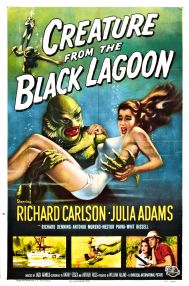 and fins, the monster is also conspicuously anthropomorphic, and the suggestion of our continuity with so strange a cousin provokes unease through a blurring of the human-animal binary.
The Creature’s crafty abduction of a human bride, Kay (Julie Adams), is of course iconic. Since the strapping lover of this damsel (Richard Carlson) refuses to commit to her outright, Gill-man’s predilection for female company hints at an exploded patriarchal fear that she is not sexually “secured”—indeed, she is also desired by a rival explorer (Whit Bissell) during the journey. Later, however, the subtext shifts and the menacing Creature seems to reflect Kay’s fear of angering her lover, since she fancies his rival right back. As these thematic adjustments suggest, the film hits a sweet-spot of anxiety and ambiguity, charging us for confrontations in which humans thrash in life-or-death struggles against the amphibious terror, as well as propelling us toward the tragic finale. 4 / 5
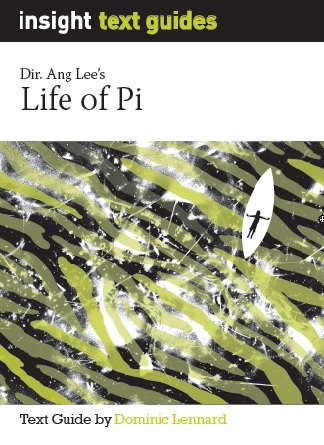
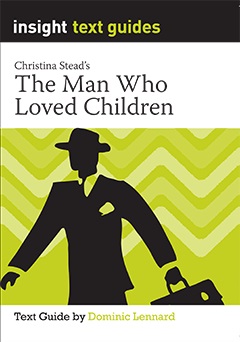 My guide to Christina Stead’s 1940 Australian classic The Man Who Loved Children has been published by Insight Publications. The Man Who Loved Children is now part of the Australian year 11-12 English curriculum, and this 73-page guide is especially designed for college-level students and their teachers. It contains: character map; synopsis; background on the writer; sections on genre, structure, and style; discussion of historical context; chapter-by-chapter analysis with key quotes and study questions; detailed discussion of themes; essay questions; guidelines for planning and writing an essay; and sample essays written to year-11/12 A+ standard.
 View at



 It's all done with mirrors