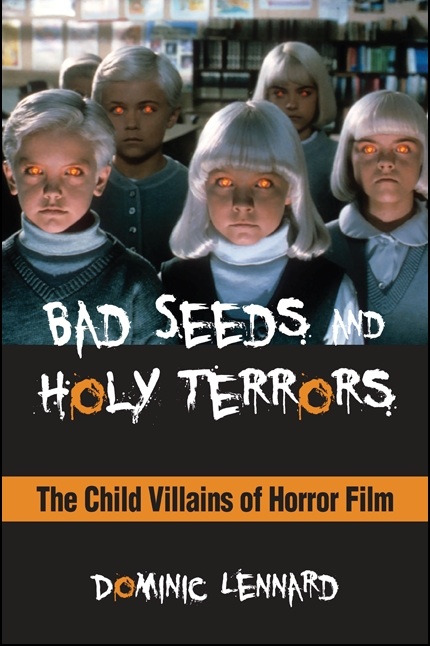
Bad Seeds and Holy Terrors: The Child Villains of Horror Film (SUNY Press, 2014)

SUNY Press, 2014 http://www.sunypress.edu/p-5921-bad-seeds-and-holy-terrors.aspx
SUNY Press, 2014

I’m delighted to announce the publication of my book, Bad Seeds and Holy Terrors: The Child Villains of Horror Film, by State University of New York Press. The book is currently available in electronic form, and the hardcover edition will be released on November 1.

This book wrangles with the numerous child villains who have haunted horror cinema over many decades, including Damien Thorn (The Omen), Regan MacNeil (The Exorcist), Samara (The Ring), and Rhoda Penmark (The Bad Seed), and the psychic terrors of Village of the Damned (pictured on the cover), among others. It interrogates in detail and with a variety of theoretical tools a cultural obsession with imagining children as objects of terror. In doing so, it highlights popular horror cinema as a vital topic of analysis, exposing it as a site of deep and volatile ambivalence toward children.

Available in print and digital form from the publisher, SUNY Press; Amazon; and others.

“This is impeccably well researched and presented. It holds its own at the top of film studies scholarship. Sprightly in its survey across key areas of cultural anxiety and able to draw on a range of lucid examples, Lennard produces sophisticated and complex extended analyses where necessary. A pleasure to read.”  — Linda Ruth Williams, University of Southampton, United Kingdom

“Deftly organized, elegantly written, and graced throughout with numerous stills and frame blowups, Bad Seeds and Holy Terrors has something to offer both the lay reader and the scholar.” — CHOICE

Reading the Bromance

Reading the BromanceI’m very thrilled to have my work included in this terrific new book on the ‘bromance’ phenomenon, Reading the Bromance: Homosocial Relationships in Film and Television, edited by the wonderful Michael DeAngelis (DePaul University), out in June from Wayne State University Press in both print and ebook formats.

Reading the Bromance examines a wide range of films and TV shows replete with bromantic affection. As well discussion and analysis of bromance staples like The 40-year-old Virgin (2005), Knocked Up (2007), Superbad (2007), and I Love You, Man (2009), the book also focuses analytical attention on texts like Grumpy Old Men (1993), TV’s House, and Scream (1996); it addresses cross-cultural bromances as well, buddies in Hindi cinema, and much more. Readers will find discussion of men engaged in bromance’s obsession with mimicking homosexuality while insisting that these displays are indeed only mimicry.

My chapter is titled “‘This ain’t about your money, bro. Your boy gave you up’: Bromance and Breakup in HBO’s The Wire.” As its title indicates, this piece focuses on the acclaimed HBO crime drama The Wire. This show probably isn’t the first thing that jumps to mind when one thinks of bromance, yet The Wire abounds with close male partnerships. Centrally and critically celebrated is the relationship between drug kingpin Avon Barksdale (Wood Harris) and his right-hand man, Russell “Stringer” Bell (Idris Elba), which is phrased in terms of family but—I argue—consolidated in a series of romantic and virtually sexual gestures.

Authors include Hilary Radner, David Greven, Nick Davis, Meheli Sen, Jenna Weinman, Ken Feil, Peter Forster, Ron Becker, Murray Pomerance, and editor Michael DeAngelis.

Praise for Reading the Bromance:

Everything you always wanted to know about the bromance, but were afraid to ask! This new volume explores contemporary masculinity, homosocial desire, and homosexual/homophobic knowing as it plays out across film and TV texts such as I Love You, Man, Superbad, The Wire, Jackass, and Humpday. In thoughtful and provocative ways, DeAngelis and his authors cover the history, forms, and multiple meanings of this curious phenomenon. Essential reading for anyone interested in contemporary models of gender and sexuality.

– Harry M. Benshoff, Professor of Radio, TV, and Film at University of North Texas and author of Dark Shadows (Wayne State University Press, 2011)

This lively and perceptive collection of essays posits the ‘bromance’ film as an ambivalent response to gay liberation and the women’s movement that allows for expanded representations of male intimacy even when operating within heteronormativity. Reading the Bromance is a valuable volume for those who want to understand the role of gender and sexuality in contemporary popular cinema.

– Mary Desjardins, author of Recycled Stars: Female Film Stardom in the Age of Television and Video and co-editor of Dietrich Icon

Reading the Bromance‘s remarkably sophisticated essays analyze the twisted generic complexity of a long history of representing male-male relations. Studying the formula’s homosocial and heteronormative behaviors, these authors demonstrate how these texts permit fluid cultural and social adventures involving emotions, maturity, gender, taste, and physicality. A terrific collection.

– Janet Staiger, William P. Hobby Centennial Professor Emeritus in Communication and Professor Emeritus of Women’s and Gender Studies.

Reading the Bromance is available in June from Wayne State University Press.


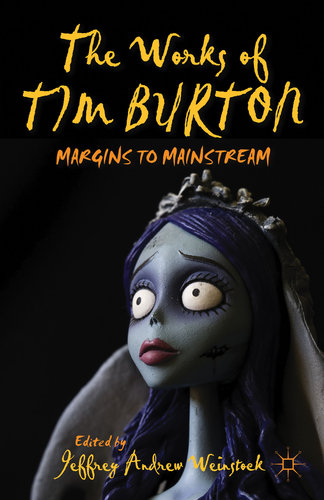
The Works of Tim Burton: Margins to Mainstream

Tim BurtonMy essay “‘This is my art, and it is dangerous!’: Tim Burton’s Artist-Heroes” is out now as a part of this splendid collection, The Works of Tim Burton: Margins to Mainstream, edited by Jeffrey Andrew Weinstock and published by Palgrave Macmillan. This book features insightful contributions by a diverse range of scholars, including Katherine A. Fowkes, Matt Hills, Murray Pomerance, Carol Siegel, Rob Latham, its outstanding editor Jeffrey Weinstock, and many others (full contents listed below). Focusing on a wide variety of topics related to this unique and culturally significant filmmaker, and examining his films from a variety of critical perspectives, The Works of Tim Burton is the most in-depth, complete and current academic study of the director’s work. Also available from Amazon, Book Depository, and Barnes & Noble online.

From the publisher:

Tim Burton has had a massive impact on twentieth and twenty-first century culture through his films, art, and writings. The contributors to this volume examine how his aesthetics, influences, and themes reflect the shifting cinematic practices and social expectations in Hollywood and American culture by tracing Burton’s move from a peripheral figure in the 1980s to the center of Hollywood filmmaking. Attentive not only to Burton’s films but to his art and poetry, this collection explores Burton’s popularity and cultural significance as both a nonconformist and a mainstream auteur.

Abstract for my chapter:

Characters with profoundly felt artistic talents and sensitivities dominate the films of Tim Burton: the introverted Edward Scissorhands (Johnny Depp) of the 1990 film of the same name stuns his detractors with a series of unlikely masterworks; Jack Skellington of The Nightmare Before Christmas (1993) is the celebritized and eagerly sought scare-artist of Halloween Town; in Corpse Bride (2005) Victor Van Dort (Depp) funnels his frustrations into musical composition. These portrayals are curiously complemented in Burton’s oeuvre by characters who appear as affected, inferior or even deadly, artists. The Joker (Jack Nicholson) of Batman (1989), for instance, pronounces himself “the first fully functioning homicidal artist,” before presenting his mutilated girlfriend as “a living work of art.” This chapter explores the foregrounding of creative art in Burton’s films, focusing especially on the figure of the artist-hero. It considers this recurring figure in relation to an auteurism that insists we recognize the “Tim Burton-ness” of each film (notice its particular artistry), traditional conceptualizations of art production, and the role of artistic practice in foregrounding individuality.

Praise for The Works of Tim Burton:

“Weinstock, who knows his unconventional filmmakers well, provides a carefully modulated trove of essays that effectively cover the Burton oeuvre, even as they demonstrate the perhaps surprising variety of his work. Each essay is a gem, with the whole adding up to a serious, provocative exploration of the films.”

–R. Barton Palmer, Director of Film Studies, Clemson University, USA, and author of Joel and Ethan Coen and Shot on Location: The Postwar American Realist Film

“Tim Burton is a phenomenon of modern film, blending the humorous, the horrific, the macabre, and the magical with extraordinary skill. Jeffrey Andrew Weinstock’s wide-ranging collection delves into Burton’s career from Frankenweenie (1984) to Frankenweenie (2012), exploring the richness of his themes, the complexity of his allusions, and the nonstop inventiveness of his visual style. A treat for Burton’s countless admirers, a welcoming introduction for newcomers.”

–David Sterritt, Professor of Film, Columbia University, USA, Chair, National Society of Film Critics


Film director Ed Wood (Johnny Depp) in Burton’s Ed Wood (1994): a unique artist—uniquely terrible.

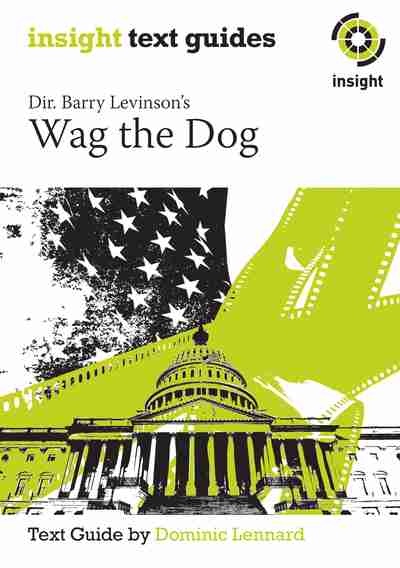
Wag the Dog (1997) film guide

Wag the Dog coverFreshly pressed: a guide to Barry Levinson’s political satire Wag the Dog (1997).  When the U.S. President is accused of making sexual advances toward a young girl in the lead-up to an election, his media advisers call in mysterious spin doctor Conrad Brean (Robert De Niro) to manage the scandal. Brean’s strategy involves concocting a fictional war with Albania to divert attention from the scandal. As this war will be an entirely a fictional production, he enlists eccentric film producer Stanley Motss (Dustin Hoffman) to “produce” it as he would a Hollywood film, and invest it with all the drama and mawkish sentimentality the media and public crave. Wag the Dog seemed almost uncannily topical when the Lewinsky scandal broke just a few weeks after its release; however, the film now also eerily recalls the artful “selling” of the Iraq War to the American public in 2003.

Wag the Dog has been added to the Australian year 11-12 curriculum, and this guide is especially designed for college-level students and their teachers. It contains: character map; synopsis; background on the writers and director; sections on genre, structure, and film style; detailed discussion of the film’s historical context; scene-by-scene analysis, with key quotes and study questions; detailed discussion of themes; essay questions; guidelines for planning and writing an essay; and sample essays written to year-11/12 A+ standard.

Available now from publisher Insight Publications, as well as Angus & Robertson, Co-op, Booktopia, and in electronic form through iBooks.  View preview.


Blue Öyster Cult live in Sydney (review)

Blue Öyster Cult

live in Sydney.

April 20, 2013, at the Hi-Fi.

Blue Oyster Cult, live in Sydney

In April of this year I was very fortunate to have the opportunity to see one of my favorite bands, New York City’s veteran rockers Blue Öyster Cult, for the first time, on their first ever tour of Australia. I journeyed from Tasmania to Sydney to see them. Although it would have been closer, their Melbourne show wasn’t an option due to work commitments. Fortunately, the Sydney show allowed me to reunite with my younger brother (also a BOC fan) for the concert, making the experience even more memorable. In addition to such classic rock hits as “(Don’t Fear) The Reaper” and “Burnin’ for You,” BOC are noted for their influence on heavy metal, for their obscure and often fantastical lyrics, and for the blistering lead-work of guitarist Buck Dharma. The band’s current line-up includes original members Eric Bloom (vocals and “stun guitar”) and Buck Dharma (lead guitar, vocals), as well as newer additions including bassist Kasim Sulton (Utopia, Joan Jett, Patti Smith), drummer Jules Radino, and guitarist Richie Castellano.

Eric Bloom

Although the band maintained a famously heavy touring schedule (especially in the US) since they burst on to the scene in the early 70s, Australia had always eluded them. Invited to the antipodes by Australian classic rockers Hoodoo Gurus for their “Dig it Up” festival event, BOC booked additional concerts in Melbourne, Sydney and Adelaide, playing these shows in their entirety without supports. Given the band wasn’t able to tour Australia during their most commercially successful years, it’s hardly an understatement to say that fans wouldn’t have dreamed of such a treat.

Many in attendance had been fans for forty years. Then there were those of us who suspect we were simply born too late to experience live the classic rock that undergirds and dominates so much of our musical taste. Particularly when we’re talking about BOC, who contributed their share to the classic rock canon, sure, but they don’t have the big touring power that comes with it. A group of impressive influence yet also a band who enjoyed their elusive imageultimately a cult band in name and nature. Yet here they were, rewarding their hard core on a strange shore, with a gig that was always going to have special and surreal resonance.

Blue Oyster Cult

All expectations were delighted by a momentous and powerful performance. The band tore through mainstays of their 70s catalogue like “The Red and the Black,” “Godzilla” and the ever-spellbinding “Then Came the Last Days of May,” as well as flashing gems from other periods of their multifaceted career, including the wistful “Shooting Shark” (from 1983’s The Revolution by Night), “The Vigil” (from the underrated Mirrors from 1979), and the screaming “Black Blade” (from 1980’s Cultosaurus Erectus). Frontman Eric Bloom commanded the stage with a veteran swagger, while gratefully acknowledging the crowd’s enthusiasm. Somewhere else in Sydney, Aerosmith and Van Halen were playing a show, one that (Bloom must have suspected) could equally have snagged the attention of the vintage rock fans in attendance. Bloom: “Thanks for coming out! I know you’ve got a lot on tonight… I hope it rains on those motherfuckers.” However, a quick glance around this crowd of glee-faced veteran rockers, many clad in faded and obscure merch from the band’s long history, would have confirmed that being elsewhere on this rare night was unthinkable.

Buck Dharma

Bloom-helmed standouts included “Cities on Flame with Rock and Roll” and “Me262”; for the latter he brandished his guitar like a strafing cannon to “See these English planes go burn!” Bassist Kasim Sulton, a legendary classic rocker in his own right, spellbound the crowd with his stuff during an extended solo; and an interlude paid tribute to his storied career as the whole band launched into snippets of hits by Joan Jett, Todd Rundgren and Meatloaf. Guitarist Richie Castellano continues to prove what a valuable addition to the band he is with his joyous stage energy and intricate, gorgeously melodic and laser-precise guitar solos of the variety that make long-time guitarist Buck Dharma such a figure of admiration. Buck himself was in very fine form, weaving his rich improvisational magic into tracks like “Shooting Shark” (brief video below) and “Then Came the Last Days of May.” His silky vocals remain untrammeled by his 65 years, as blissful renditions of the above indicated, as did stellar performances of hits “Burnin’ for You” and (of course) “(Don’t Fear) the Reaper”.

In recognition of his role in bringing BOC to Australia, Brad Shepherd of Hoodoo Gurus joined the band on stage during “Last Days of May” and a cover of Steppenwolf’s “Born to be Wild.” During one or the other an ecstatic front-row fan managed to get Shepherd’s ear and impart his deep thanks. Shepherd (who claims to know how to play every BOC song from their first five albums) spread a Cheshire grin as he took position to play amongst his influencers: “I’m pretty happy about it myself!” Weren’t we all.

The Fires (poetry)

At night can we see those who remain,
The last of the tribes that have eluded us.
Their campfires gleam and flare
In the forested hills far above.
Bright and beady and silent.

They give away their positions,
And we efficiently chart them.
Although in the morning we find nothing.

Sometimes the fires seem to burn the wrong colour,
A deep and queerly glimmering crimson.
Those captured and enslaved
Tell us nothing of their people’s movements or rituals.

We could mobilise when we see the fires.
Steal and hack through the undergrowth,
Creep up on their chants and murmurs,
Ring forged steel so much louder
Against their skulls.
Rape those worth raping;
Cut down their hags.
Throw their brats on the fire.

Instead we fortify the perimeter.
Whip the captured harder.
Reduce their skin to welts, bruises, striations.
Write woe on their faces.
Draw from them whimpers as primitive as those
Of stray dogs starving at a city’s edge.

All under the wretched gaze
Of those wrong-coloured fires.
Each one winking death
Like a bad star.

Aphelion - June 2013

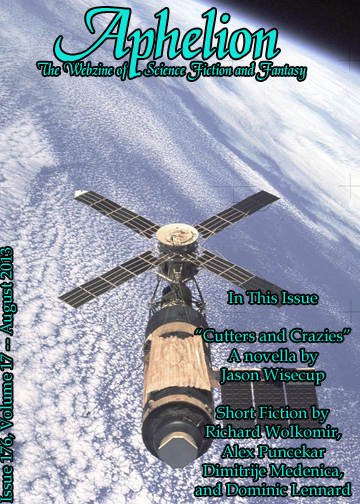
Published in Aphelion: Webzine of Science Fiction and Fantasy,
issue 174, vol. 18, June 2013. URL.

The Root (short fiction)

2700 words. Originally published in Aphelion: Webzine of Science Fiction and Fantasy, issue 173, vol. 17, May 2013. URL.

The Root

Dominic Lennard

“Sure ain’t no carrot,” Harry Woodward mumbled not quite to himself, excavating a scab of caked dirt from the side of the object with his thumbnail, a thin shower of the stuff reaching back down to the ruptured earth. “Feels a little like a carrot,” he muttered a little louder, while continuing to probe the skin beneath, wary of displacing the minute hairs whose destruction would make replanting it—whatever it was—impossible. As he drew it from the earth, he noticed a score of glittered strands, spider-web thin, swoop and snake back into the earth. Snails all through this garden, he remembered patiently—just motes of snail-tracked dirt.

He’d spotted the plant a few weeks earlier among the carrots (hence his carrot-focused incredulity): a root vegetable of some kind, a peculiar shade of blue, rounded, but knobbly and nuanced, almost segmented, topped by a small fountain of blue-green leaves.

His wife Petty called to him across the yard from her deckchair, where she was pasting photographs into an album: “What’re you doing, you old menace—uprooting the vegetables?”

Harry’s response was thoughtfully belated. “Come and look at this.”

“I’ll wait till you bring it over here… What is it?”

“I don’t know what it is… I’ve never seen anything quite like it.”

“Well it’s something, isn’t it—put it back and leave it be.”

Petty wasn’t surprised at his interest in the unidentified root, being well used to his taxonomical compulsions: botany, mechanics, early race cars and biplanes, as well as animalia—especially birds and fish. Harry pored over books, losing himself in elaborate subsets of wing and gill. She’d smiled tolerantly at his fascination with the avian encyclopaedia she’d bought him for his sixty-fifth and most recent birthday. They’d wound up missing their dinner reservation as he inspected the diagrams, let it slip away down the hollow of a bird bone.

“I’m bringing it in.”

“Well dust it off, I just vacuumed,” she said, not having vacuumed for some time.

“Can’t dust it, it’ll loose the root hairs.”

“Bringing it in!” Harry re-announced with sudden vigour, as if passing an order down through the ranks on a battleship (battleships were another interest): “Here we go.”

Petty always planned to follow him inside, but at least ten seconds later, wary of the effect of too much enthusiasm on her excitable husband.

Inside, she leaned over the table. “It’s probably just a discoloured radish. Pretty, though.”

“It’s too big for a radish.”

“Then it’s too big for a radish.”

“So…?”

“So odd things grow, big whoop.”

“I suppose some bird from abroad could have dropped it—the seed I mean. Some exotic thing …”

Having pecked his sandpapery cheek, Petty was already on her way back outside to resume pasting. “Mayyyy-beeee,” she sang out with an elongated ironic dip, as if blown through a slide whistle.

Harry had met Petty at the funeral of a mutual friend four years ago (Frank Stark, heart attack). She was twenty years younger, floppy hat-wearing, big-hipped and quick-witted. Harry couldn’t remember the exact details of their meeting, as if they’d bobbed up alongside each other like two pieces of driftwood; although it occasionally bothered him that he couldn’t recall the circumstances of their union—build the case, trace the progression of her interest in him. In retrospect, with the doom of old Starky’s sudden expiration thick in the air, Harry thought a new start with an old timer would be the farthest thing from Petty’s mind. But she was like that: breezy, pragmatic, immune to superstition. And with a reasonable bustle at his age, he thought, perhaps she considered him a reliable model.

He held in his hands a pale blue ball, firm to touch, covered in fine moist root hairs; it was perfectly rounded and pleasantly cool from the earth. The garden was large and he frequently lost track of what was growing where. New plants were devoured by snails and forgotten, while obscure and forgotten ones thrived unattended. Five years ago, when he’d needed to move the vegetable patch from one end of the garden to another he’d been able to replant potatoes and carrots with a lot of success: “all about the hairs,” he reminded himself. Good thing Petty didn’t feel the same, he thought, removing his sunhat.

Three hours later Harry was still engrossed.

“Still probing the mysteries of the rogue bulb?” Petty questioned, smiling covertly while not looking up from the postcard she was writing.

“Still don’t know what it is. Could be a big find. Your Harry could be famous—be in all the books. Maybe I’ll call it a Pet-ato.” He turned and grinned teasingly.

She looked up and smiled back. “Do you even listen to yourself?—Petunia’s already a plant, you goose.”

Harry paused, disassembled then reassembled his smile with tacky mock-embarrassment—a self-deprecating flourish he imagined she found charming or youthful—and swivelled back to the grotty blue mound on the table.

An hour or so later he pressed a glass of wine to his lips as he towed his gaze through another page of genera in his thickest botanical volume. Petty strolled into the room, bringing with her the benevolent comet-tail of the day’s energy and sat down at the table. “I thought we might play a game, Scrabble or something.”

“Well, love, I’m a little into this root at the minute.”

“Oh Harry. Well… Do you know what it is yet?”

“Nope.”

“You’ll never be happy till you know what it is?”

“Nope.”

She responded with a sigh as she left the room, flappy and overstated like a deflating balloon—determined that her defeat would be if not satisfying then playfully theatrical.

The colour seemed slightly different, richly blue, more preternaturally verdant. It had changed, he was sure of it—yes, it was visible now, plainly. Its blueness had an almost oceanic tinge.

Petty drifted into the room again a few minutes later.

“Look at this,” Harry murmured, “Tell me if the colour’s changed. Well, no—I’m telling you it’s changed . . .”

“So it’s changed. Has it? Well maybe it has.”

“Doesn’t that strike you as odd?”

“Should it?”

“Well, yes. I think it’s odd.”

He was faintly annoyed by her indifference—and her ability to phrase it with an oblique but actual intelligence, as if its oddness was in fact the most familiar thing in the world.

Harry was not a religious man, but he wondered if the vegetable was supernatural, somehow. It had an electricity, a tingling bloodwarmth. He felt its texture on his hands after having put it down—felt the bristles, the weight of it in his hands.

That night, in bed, Harry felt harassed by the impossibility of it, of something impossible already inside the realm of the possible. He was faintly horrified by its intrusion, its questioning of all knowledge: an intolerable mystery enforcing the silence of night.

Later he awoke, wheeled about by dreams, and made a cup of tea. He found himself replaying a scene in his mind, trying to orchestrate it into familiarity, rehearse it into some kind of shape. Two days ago his son, David, had come to talk to him. “I’m moving to New Zealand,” he’d said, “taking Nora and the kids.”

Harry’s first instinct would have been to reach for atlas or almanac—contemplate population density, let his eyes waltz around the crenulations of relief maps, peaks, basins. He had been to New Zealand, or to the airport anyway; although the prospect of his son’s permanent departure meant he didn’t imagine New Zealand but some unreal place: lunar, darkly utopic, a pencil-coloured place with giant plants and windowless skyscrapers, with darkness that crept in the ears.

He’d drank from a glass of water on the table.

He had raised his son to take on the world, now he was.

Petty’s excitement for the boy alerted Harry to his own, legitimised it—gave it daylight and some genuine satisfaction. She assigned for him a place in this event, spiriting him across a ravine with a wifely assurance he both valued and in some obscure way distrusted.

That evening Harry spoke on the phone to his ex-wife, Nancy, David’s mother, without saying very much. Nancy spoke of the scene as a universal but unacknowledged pain of parenthood, some sombre twilight adolescence. She was glad he had called, hinting at her own barely managed feelings of sorrow and attachment. Harry could tell that her elation at the event itself (and she had, according to David, been elated) was the role her son needed her to play: a parental rite of self-sacrifice, the more noble and tragic for remaining unannounced.

As he sat, drinking his tea, he wondered at the differences in their relationship to David, about the boy they each knew. He had always beheld his son with a thoughtful reserve, a concise affection, potent in its economy. David grew for him like a tree, in wondrous but ultimately un-alarming extensions. He didn’t know her son: uncertain, caressed by fog-fingered apparitions of childhood—tickles, wet-beds, nosebleeds, bedsocks, the warmth of hair. He did not know the language of cold toes. He did not begrudge Nancy her access to this son, but sometimes felt absorbed in his distance from it, exiled by the realisation that even in his own life there were things he could not know.

Exhausted by the thought, he walked to the bathroom and splashed his face. He raised his head to the mirror to inspect his appearance: like a gnawed apple, he felt, all sudden divot and overhang. He ran a hand down his whiskers. If he had thought longer on it (which he wouldn’t), Harry would probably have considered himself a handsome enough man for his age. Not “handsome”—handsome enough: which for Harry meant tolerable, efficiently not abhorrent. He wondered dimly about his relationship to his face. He did not feel uncomfortable with his appearance, merely disconnected from it, as if its representation of him in the world, its emotional register, was totally arbitrary. If this was the face Petty saw and spoke to, well—he did not know what to think of that.

Suddenly he heard a kind of padded bump, and moved silently across the carpet toward the bedroom, uneasy but in a procedural way, like a new homeowner wary of unfamiliar geometry, of sighing beams and stowed energy. Petty lay sleeping, ensconced in the sheets like a benevolent mummy. Just the pipes groaning.

He wondered to himself whether he could sit on the bed without waking her, and did so, his eyes absorbing the peace of her sleeping form. Then he pondered how her body could be so close—he could feel the warmth coming off it—while she was so far away, rolling through the condensed time of dreams. Petty had no children, and he wondered if this troubled her dreams, whether this was something she towed through the otherworld (perhaps right now), and felt an obscure guilt—the muffled guilt of association. She awoke and sat up, as if from a trance, blinking back the netherworld.

“Honey . . . are you all right?”

“Yeah, sorry I woke you.”

*

“Do you want toast?” Petty enquired at breakfast, and through a mouthful of toast.

“No thanks, love,” Harry replied, turning through the newspaper without reading it, although occasionally leaning his gaze against the symmetry of the paragraphs. Petty was going to the hospital to visit a friend, veteran of some minor procedure—which of course, at their age, they all were. He vaguely resented her absence but couldn’t think of a reason why, nor any excuse as to why she shouldn’t go. After she left, though, he went outside and smoked a cigarette with a self-conscious petulance. Afterward, he went inside and ate toast and drank coffee, letting them decontaminate his mouth, bustle away the smell. Petty did not care whether he smoked occasionally, yet he felt beholden to the act’s concealment—incriminated by the rhythms of his smoking mind, the gentle deathward sway of all secrecy.

He returned to the root, flipping back through another book, annoyed at his inability to focus on the task and at a sneaking suspicion that he was becoming a time-waster. Upon grasping the root, he imagined it was warm but could not tell whether it was merely the warmth of his meddling hands permeating the vegetable’s indifferent flesh.

That afternoon he thought of calling his doctor, and did so without further thought. A man of science is what he needed—any science—someone licensed to propose and perform excision, biopsy, autopsy. He left a message with the receptionist requesting that Dr Miller call him back. When Miller called, Harry, presuming an equivalent male-interest in the Facts Of Things, launched right into a detailed description. Miller ummed and ahhed, then tried to shift the conversation to Harry’s diabetes medication. Miller hung up with the advice that mutations, despite their irregularity, were regular—Harry shouldn’t get himself too worked up.

A Western was on television, and Harry watched until his eyelids drooped and his body seemed to slink into itself. He dreamt of the root: it began to wobble back and forth on the table, like an egg although he knew—somehow—that it was not an egg. He felt energy radiating from it, invisible belts of energy expanding out into the atmosphere, and was terrified by what it might do next. It seemed to him volatile, explosive, some cosmic vegetative grenade. In his dream he moved behind a chair as the thing continued to judder—jump, even—it jumped on the table, its hairs suddenly singed, fired to specks. Its surface area began stripping as if planed away by an invisible peeler . . .

Petty woke him. “Let’s play Scrabble.”

He looked at the root on the table next to them as they played, and could not reconcile it with its dream version, so saturated in dread. Nevertheless, he couldn’t channel his attention into the game. Glancing at his letters, Petty proceeded to point out three different words he’d failed to realise.

“I’m just not up to it tonight I suppose,” he offered affably.

“But you love Scrabble . . .”

He smiled, weakly, and began rearranging his letters in a quiet gesture of confirmation. The letters seemed to break away from one another, as if belonging to different times and alphabets. Petty went on: “You know I don’t even like Scrabble that much, I play because you like Scrabble.”

This was news to him.

“Are you all right?”

He told her that he was—still touched by her fraudulence, by the truthfulness of it.

The next morning, he unsheathed the trowel from the moist earth and cleared a space for the root. He paused, considering one last time whether it wasn’t worth thoroughly rummaging: photographing it, contacting a professional, cutting it open and mailing it somewhere to men with white coats and microscopes. There was a camera inside the house, although as soon as he thought of photographing it he was struck by the idea’s uselessness. He then nestled the object in the hole, delicately drew the soil around it like a blanket around a sleeping child, and made his way inside.

Within a few weeks he had lost sight of it. The surrounding species seemed to have multiplied; the patch dense with explosions of green, fresh and trembling now with water from the sprinkler. He had to admit that he could not remember exactly where he had planted it. Perhaps it had even decomposed?—its wild leaves leaching into the dark soil below. . . Ready to retire for the night, he paced idly over to turn off the tap. After easing it closed, he again padded across the wet lawn to the garden, re-saturating his socks, and rested his sleepy gaze contentedly on the puddly black earth glittering before him—a sapphire ocean holding its breath. He thought of the vanished root as he watched pools silently form and dissipate, the tiny runnels chasing each other through the ancient soil, firing off stars in the darkness.